Stop the Shopping Spiral: A Calm Process for Better Buys

When Shopping Triggers Anxiety: Common Patterns That Keep Repeating
Shopping anxiety often shows up as a familiar loop: a “quick” browse turns into hours of comparing, second-guessing, and feeling worse than when you started. It’s rarely about one shirt or one pair of jeans—it’s the pressure to pick perfectly, the fear of wasting money, and the worry that your choices say something about you.
These are some of the most common patterns:
- Overwhelm from too many choices (endless colors, fits, micro-trends, and “must-have” lists).
- Fear of wasting money or choosing the “wrong” item and regretting it later.
- Body image stress that spikes in fitting rooms, mirror checks, or photos.
- Decision paralysis: add to cart, abandon, repeat—without clarity.
- The emotional hangover: guilt, returns, clutter, and a growing sense of “I can’t trust myself.”
The Shopping Anxiety Cycle (and Where It Can Be Interrupted)
Once you can name the cycle, it becomes easier to break. Anxiety thrives on urgency and uncertainty—both of which are baked into modern shopping. The goal isn’t to “love shopping.” The goal is to shop with a process that keeps you grounded.
Here’s the cycle in plain terms:
- Trigger: a season change, event invite, social comparison, or a closet “crisis.”
- Thought loop: “Nothing looks good,” “I don’t know my style,” “I’ll regret this,” “I need the perfect option.”
- Behavior: doom-scrolling, panic-buying, compulsive browsing, or total avoidance.
- Short-term relief: buying something or quitting for the day lowers anxiety briefly.
- Long-term cost: returns, budget stress, clutter, and less trust in your judgment.
Cycle Snapshot: What’s Happening and What Helps
| Cycle moment | What it can feel like | A practical interruption |
|---|---|---|
| Trigger | Urgency, pressure, comparison | Name the trigger and set a specific shopping goal (one need, one category) |
| Thought loop | Perfectionism, self-criticism | Use a “good-enough” rule and a short list of fit/style requirements |
| Behavior | Endless browsing or avoidance | Time-box shopping and limit tabs/stores to reduce cognitive load |
| Short-term relief | Temporary calm after buying or quitting | Delay checkout 24 hours or create a return plan before purchase |
| Long-term cost | Regret, clutter, money stress | Track wins: cost-per-wear intent, closet gaps, and what was actually used |
Why Style Uncertainty Feels So Personal (and So Stressful)
Life transitions can intensify this. A new job, postpartum body changes, moving to a different climate, aging, or shifting routines can make old “rules” stop working. Then marketing steps in with urgency and “fix it now” messaging, which can amplify self-doubt instead of easing it. For background on how anxiety works and why it can feel so persistent, see the American Psychological Association overview of anxiety and the National Institute of Mental Health guide to anxiety disorders.
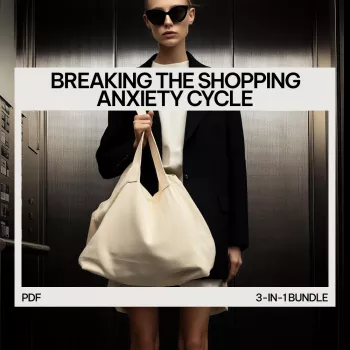
What’s Inside the Breaking the Shopping Anxiety Cycle Bundle
If shopping has become emotionally loud—too many opinions, too much pressure, too many “almost” purchases—the most helpful shift is moving from “hope I figure it out” to “follow a repeatable process.” The Breaking the Shopping Anxiety Cycle Bundle is built around that idea: reduce overwhelm before browsing begins, clarify what actually works for your real life, and rebuild trust through smaller, lower-risk decisions.
Quick Guide: Who This Bundle Helps Most
| If this sounds familiar | What to focus on first |
|---|---|
| “Shopping makes me anxious and exhausted.” | Reduce options: pre-select stores, fabrics, silhouettes, and a strict time limit |
| “I buy things, then regret it.” | Create a 24-hour pause + a return/alteration plan before checkout |
| “I don’t know my style anymore.” | Build a small style vocabulary from outfits already worn and liked |
| “I avoid shopping until it’s an emergency.” | Make a seasonal essentials list and buy one item at a time on purpose |
A Calmer Way to Shop: A Simple 5-Step Routine
If travel or seasonal routines also contribute to “I need to get it right” pressure, pairing a style-decision system with a simple packing framework can reduce last-minute panic. For example, One Bag, Two Weeks, Zero Stress – How to Pack a Carry On for Two Weeks supports calmer planning when an upcoming trip is the trigger. And when winter discomfort adds another layer of urgency, Winter Survival Skincare Tips Bundle can help simplify one more decision stream.
Keeping Progress: Closet Trust, Not Closet Perfection
When to Get Extra Support
If shopping anxiety is part of broader anxiety, compulsive spending, or significant distress, extra support can be a strong next step. Approaches like CBT (cognitive behavioral therapy) can help challenge perfectionism, catastrophizing, and avoidance patterns; the Cleveland Clinic’s CBT overview explains how it works. If spending feels out of control or tied closely to mood, a financial counselor or therapist can also help create safer guardrails. If body image distress feels intense, support that focuses on body image and self-compassion can reduce triggers and make try-ons less activating.
FAQ
Why does shopping make me anxious even when I need something?
Shopping can trigger choice overload, fear of regret, and pressure to “prove” you’re making the right decision—especially when body image or perfectionism is involved. Often the anxiety is about uncertainty and evaluation, not the clothing itself.
How can shopping be less overwhelming when there are too many options?
Set boundaries before you browse: a time limit, a budget cap, and a short requirements list (plus 1–2 dealbreakers). Decision rules—like a 24-hour pause before checkout—reduce impulsive swings and make choices feel safer.
What if I don’t know my style anymore?
Start with what you already wear in real life: identify a few outfits that feel comfortable and “like you,” then name what they have in common (colors, silhouettes, fabrics). Rebuild confidence by buying one low-risk item at a time rather than trying to reinvent everything at once.











Leave a comment